Best Cordless Nailers: 2026 Buying Guide
Written By
CordlessToolz Editorial
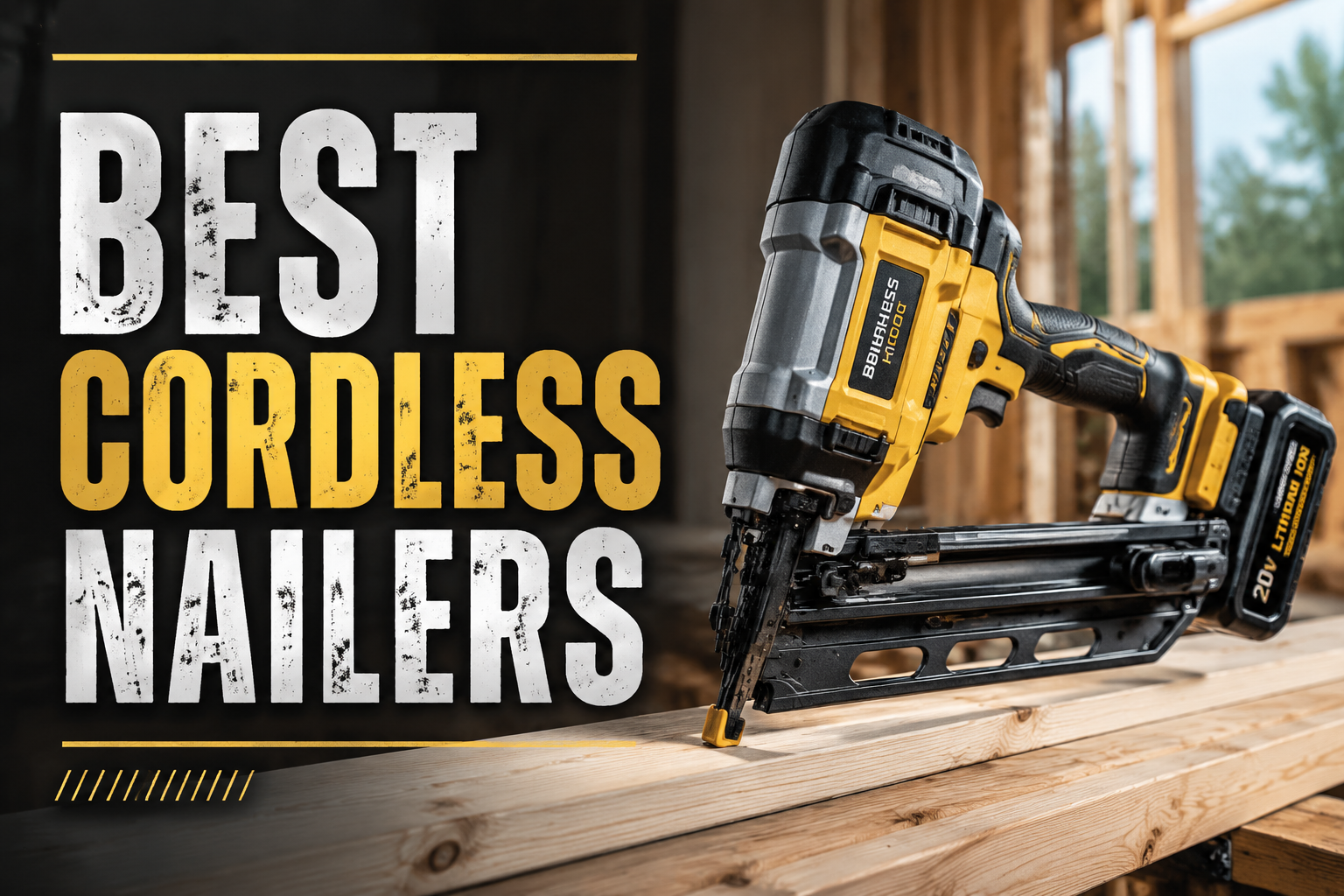
The rhythmic thud of a pneumatic nailer, once the undisputed soundtrack of any serious construction site or woodworking shop, is slowly but surely being replaced by a quieter, more agile hum. In 2026, the shift towards cordless tools has reached an undeniable tipping point, and nowhere is this more evident than with nailers. For enthusiasts and professionals alike, understanding the best cordless nailers available is no longer a luxury but a necessity. These innovative tools offer unparalleled freedom, efficiency, and precision, fundamentally changing how projects are approached, from intricate trim work to robust framing.
Key Takeaways
- Cordless nailers offer significant advantages: Freedom from hoses and compressors, increased portability, and faster setup times are revolutionizing job site efficiency.
- Variety for every task: From delicate brad nailers to powerful framing nailers, there's a cordless option tailored for virtually every fastening need.
- Performance rivals pneumatic: Modern battery technology and motor design mean many cordless nailers now deliver power and consistency comparable to their pneumatic counterparts.
- Consider key features: Battery voltage, nail gauge, drive depth adjustment, and jam-clearing mechanisms are crucial factors when selecting the right tool.
- The DeWalt 20V Max 18-Gauge Brad Nailer (DCN680) stands out: This model is a top contender for its balance of power, ergonomics, and reliability, making it an excellent choice for finish and trim work.
The Cordless Revolution: Why Choose the Best Cordless Nailers in 2026?
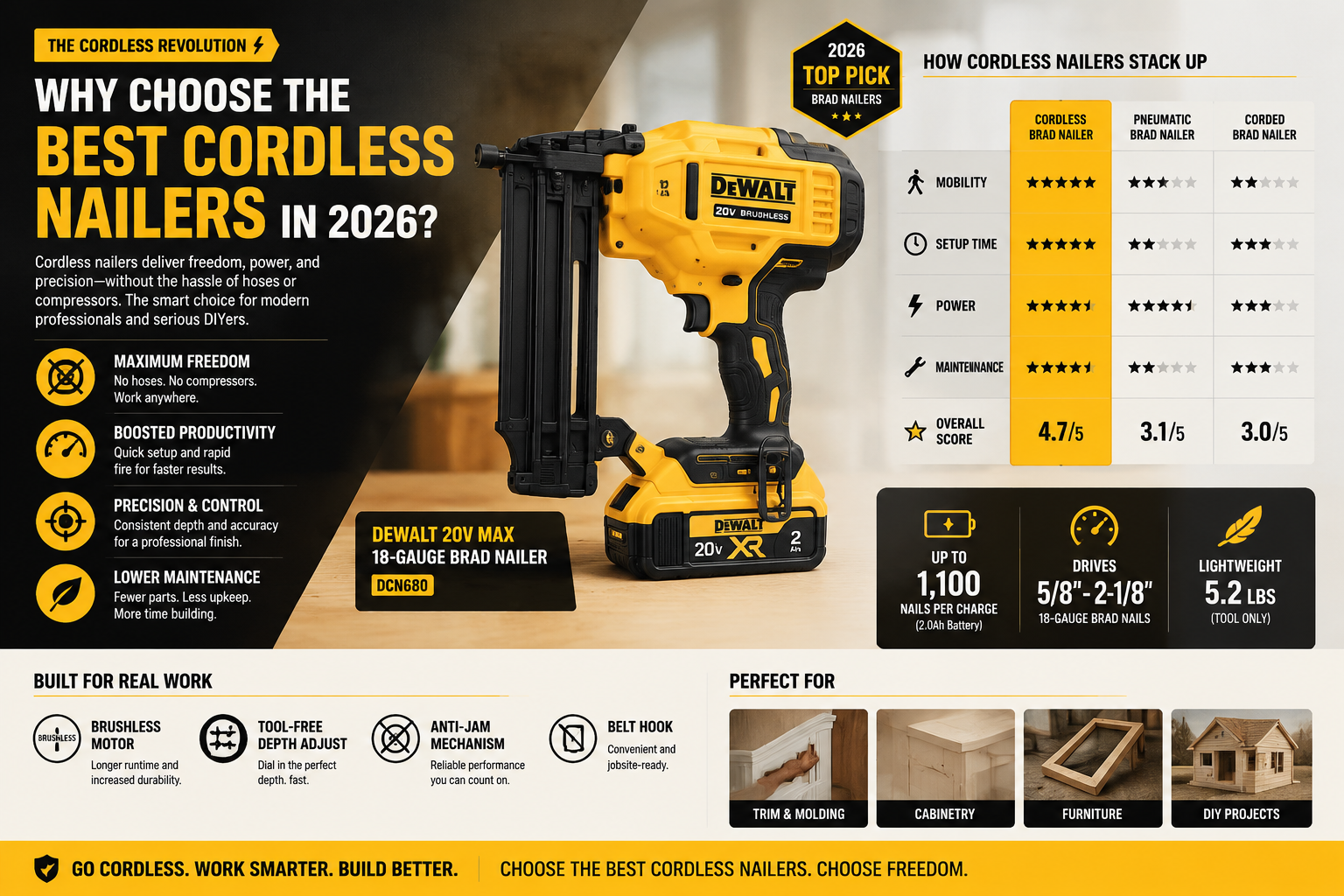
Gone are the days when a dedicated air compressor and a tangle of hoses were prerequisites for serious nailing tasks. The best cordless nailers of 2026 have liberated tradespeople and DIYers from these constraints, ushering in an era of unprecedented convenience and mobility. But what exactly drives this revolution, and why should you consider making the switch if you haven't already?
The primary allure is, naturally, freedom. Imagine tackling a trim installation without dragging an air hose through multiple rooms, or framing an outdoor shed without needing an extension cord for your compressor. Cordless nailers eliminate this hassle, allowing you to move seamlessly around a job site or workshop, focusing entirely on the task at hand. This not only saves significant setup and pack-up time but also enhances safety by removing trip hazards.
Beyond convenience, modern cordless nailers deliver impressive performance. Advances in brushless motor technology and high-capacity lithium-ion batteries mean that many models now boast firing power and consistency that rivals, and in some cases even surpasses, traditional pneumatic tools. This is particularly true for specialized tools like brad nailers, which are designed for precision and finesse in finish work.
Advantages of Cordless Nailers
- Portability: Work anywhere without power outlets or compressors.
- Faster Setup: No hoses, no compressors, just load and go.
- Increased Safety: Reduced trip hazards and no loud compressor noise.
- Versatility: Many systems share batteries across a wide range of tools.
- Precision: Excellent control for intricate tasks like trim and molding.
Exploring the Landscape of Best Cordless Nailers
The market for best cordless nailers has diversified significantly, offering specialized tools for virtually every application. Understanding the different types is crucial for making an informed decision.
Brad Nailers (18-Gauge)
Brad nailers are perhaps the most popular category for enthusiasts and interior finish work. They use 18-gauge nails (brads) which are thin, leaving small holes that are easy to fill. They're perfect for:
- Attaching delicate trim and molding
- Securing thin panels
- Craft projects and small assemblies
- Upholstery work
One standout in this category is the DeWalt 20V Max 18-Gauge Brad Nailer (DCN680). Known for its consistent depth setting, tool-free jam clearing, and excellent ergonomics, it's a favorite among professionals for its reliability and ease of use.
Finish Nailers (16-Gauge & 15-Gauge)
Finish nailers use thicker nails (16-gauge or 15-gauge) which provide a stronger hold than brads. They're ideal for:
- Installing baseboards and crown molding
- Attaching door and window casings
- Cabinet construction
- Furniture making
The choice between 16-gauge and 15-gauge often depends on the material and desired holding strength. 15-gauge nails, often angled, are slightly stronger and less prone to splitting harder woods.
Framing Nailers (21-Degree & 30-Degree)
These are the heavy-hitters, designed for structural work. They drive large, common nails (typically 2 to 3-1/2 inches) into lumber. Cordless framing nailers have made massive strides in recent years, now capable of keeping up with pneumatic counterparts on many job sites. They are essential for:
- Building walls and roofs
- Deck construction
- Fencing
- Heavy-duty wood assembly
Pin Nailers (23-Gauge)
Pin nailers use extremely thin, headless pins (23-gauge) that are virtually invisible. They offer a temporary hold or can be used for very delicate applications where even a brad nail might be too large. Perfect for:
- Holding glue-ups while drying
- Attaching very thin veneers
- Decorative trim work that requires minimal fastener visibility
Anatomy of the Best Cordless Nailers: Key Features to Look For
When evaluating the best cordless nailers, several features distinguish top-tier models from the rest. Understanding these components will help you select a tool that perfectly matches your needs.
- Battery System: The voltage (e.g., 18V, 20V, 40V) and amp-hour (Ah) rating of the battery determine the tool's power and runtime. Investing in a platform with interchangeable batteries across multiple tools (like DeWalt's 20V MAX system) is often cost-effective and convenient.
- Motor Type: Brushless motors are generally preferred over brushed motors. They are more efficient, run cooler, offer longer tool life, and provide better power delivery per charge.
- Firing Mechanism:
- Flywheel (or Inertial) System: Common in many brad nailers and finish nailers. A spinning flywheel accelerates a driver to impact the nail. These are generally faster but can have a slight ramp-up time.
- Nitrogen Spring/Compressed Air: Some high-end cordless nailers use a sealed compressed air cylinder or nitrogen spring for powerful, consistent firing, mimicking pneumatic performance without the external compressor.
- Combustion (Gas-Powered): While technically cordless, these use small fuel cells and a spark to create an explosion that drives the nail. They are powerful but require fuel cell replacement and produce exhaust.
- Depth Adjustment: A tool-free depth adjustment knob or lever is crucial for countersinking nails perfectly, regardless of material density.
- Jam Clearing: Jams are inevitable. Look for tools with easy, tool-free access to clear jammed nails quickly, minimizing downtime. The DeWalt 20V Max 18-Gauge Brad Nailer (DCN680) excels here.
- LED Worklight: A built-in LED light illuminates the work surface, improving visibility in dimly lit areas.
- Sequential vs. Contact Actuation:
- Sequential: Requires the user to press the safety tip against the work surface, then pull the trigger for each nail. This is generally safer and more precise.
- Contact (Bump) Fire: Allows the user to hold the trigger down and fire nails by simply "bumping" the safety tip against the work surface. Faster for repetitive tasks but requires more caution. Many cordless nailers offer both modes.
- Magazine Capacity and Loading: A larger magazine means less frequent reloading. Top-loading or side-loading magazines are common, with side-loading often being quicker.
- Ergonomics and Weight: For extended use, a balanced, comfortable grip and manageable weight are essential to reduce fatigue.
Deep Dive: The DeWalt 20V Max 18-Gauge Brad Nailer (DCN680)
When discussing the best cordless nailers, especially in the brad nailers category, the DeWalt 20V Max 18-Gauge Brad Nailer (DCN680) consistently emerges as a top performer. This tool exemplifies the advancements in cordless technology and why many professionals trust it for critical finish work.
Key Features and Performance:
- Brushless Motor: The DCN680 utilizes a brushless motor, providing excellent runtime and durability. Users can expect to drive hundreds, if not over a thousand, brads on a single 2.0Ah battery charge, depending on the material.
- Consistent Driving: A consistent firing mechanism ensures each brad is driven to the desired depth without adjustment, a critical factor for clean finish work.
- Tool-Free Depth Adjustment: Easily dial in the perfect depth for different materials, from soft pine to dense hardwoods.
- Tool-Free Jam Clearing: If a jam occurs (rarely, in practice), the DCN680 allows for quick and effortless clearing without needing additional tools, minimizing downtime.
- Selectable Actuation Modes: Switch between sequential mode for precision placement and bump mode for production speed.
- Ergonomics: DeWalt prioritizes user comfort. The DCN680 is well-balanced, comfortable to hold for extended periods, and relatively lightweight, reducing user fatigue.
- Integrated LED Light: Illuminates the work area, especially useful in poorly lit conditions or when working in cabinets.
Why it's a Top Choice:
The DCN680 stands out for its exceptional reliability and user-friendly design. It consistently drives brads cleanly and precisely, leaving minimal holes that require little to no filling. For trim carpenters, cabinetmakers, and serious DIYers, this nailer is a game-changer, offering pneumatic-like performance without the associated setup and bulk. Its integration into DeWalt's extensive 20V Max battery platform adds further value, allowing users to share batteries across a wide array of tools.
Cordless vs. Pneumatic Nailers: Making the Right Choice
The age-old debate between cordless and pneumatic nailers continues, but in 2026, the lines are blurrier than ever. Both have their place, and the "best" option often depends on the specific application and user preference.
Pneumatic Nailers
- Pros:
- Raw Power: Historically, pneumatics offered superior power for heavy-duty applications like framing, though cordless options are catching up.
- Consistent Firing: As long as the compressor maintains pressure, firing is extremely consistent.
- Lighter Tool Weight: The tool itself is often lighter since it doesn't house a battery or motor.
- Lower Initial Cost (Tool Only): The nailer itself is usually cheaper, but factor in the compressor, hoses, and fittings.
- Cons:
- Requires Compressor and Hoses: Bulky, noisy, and creates trip hazards.
- Maintenance: Compressors require maintenance, and hoses can leak.
- Limited Mobility: Tied to the compressor's location.
Cordless Nailers
- Pros:
- Unmatched Portability: Work anywhere, anytime.
- Quick Setup: Grab and go.
- Reduced Noise: Significantly quieter than a compressor.
- Increased Safety: No hoses to trip over.
- Integrated Battery Platforms: Batteries are often interchangeable with other power tools.
- Cons:
- Initial Cost: Often higher than pneumatic equivalents, especially when factoring in batteries and chargers.
- Weight: Generally heavier due to the battery and internal motor/mechanism.
- Runtime: Battery life is finite and requires recharging.
- Maintenance: Batteries degrade over time.
When to Choose Which:
- Cordless: Ideal for smaller projects, punch-list work, trim and finish carpentry where mobility is key, working in noise-sensitive environments, and any situation where setting up a compressor is impractical or time-consuming. For most enthusiasts, the convenience of the best cordless nailers like the DeWalt 20V Max 18-Gauge Brad Nailer (DCN680) makes them an easy choice.
- Pneumatic: Still preferred for continuous, high-volume production work in a fixed location (e.g., a dedicated framing crew working on a new build's walls all day), where the compressor's consistent power and potentially lighter tool weight (over hours of use) might still offer an edge.
Conclusion
The evolution of cordless technology has transformed the power tool landscape, and cordless nailers stand at the forefront of this revolution. In 2026, these tools are no longer niche products but essential equipment for anyone serious about woodworking, construction, or home improvement. The freedom from hoses and compressors, combined with ever-increasing power and precision, makes them an invaluable addition to any toolkit.
Whether you're a professional trim carpenter seeking the reliability of a DeWalt 20V Max 18-Gauge Brad Nailer (DCN680) for flawless finish work, or a dedicated DIYer looking for versatility across various projects, there's a cordless nailer perfectly suited to your needs. When selecting your next tool, prioritize battery platform compatibility, motor type, and critical features like depth adjustment and jam-clearing mechanisms. By making an informed choice, you'll unlock unparalleled efficiency and convenience, allowing you to tackle projects with greater speed, safety, and confidence.
Actionable Next Steps:
- Assess Your Needs: Determine the primary types of nailing tasks you'll be performing (e.g., trim, framing, delicate crafts) to identify the appropriate nailer gauge.
- Evaluate Battery Platforms: Consider investing in a cordless system where batteries are interchangeable across multiple tools from the same manufacturer.
- Read Reviews and Watch Demos: Research specific models, paying attention to user feedback on performance, ergonomics, and reliability.
- Visit a Local Retailer: If possible, handle different models to get a feel for their weight, balance, and overall comfort before purchasing.
SEO Meta
Meta Title: Best Cordless Nailers 2026: DeWalt 20V Max Brad Nailer Guide
Meta Description: Discover the best cordless nailers for 2026, including the top-rated DeWalt 20V Max 18-Gauge Brad Nailer (DCN680). Find expert tips for optimal projects.
Tags
cordless nailers, DeWalt, DeWalt 20V Max, brad nailers, finish nailers, framing nailers, power tools, woodworking, home improvement, tool review, DCN680, 2026 tools